History of the castle
I
A castle on the edge of Kerestinec
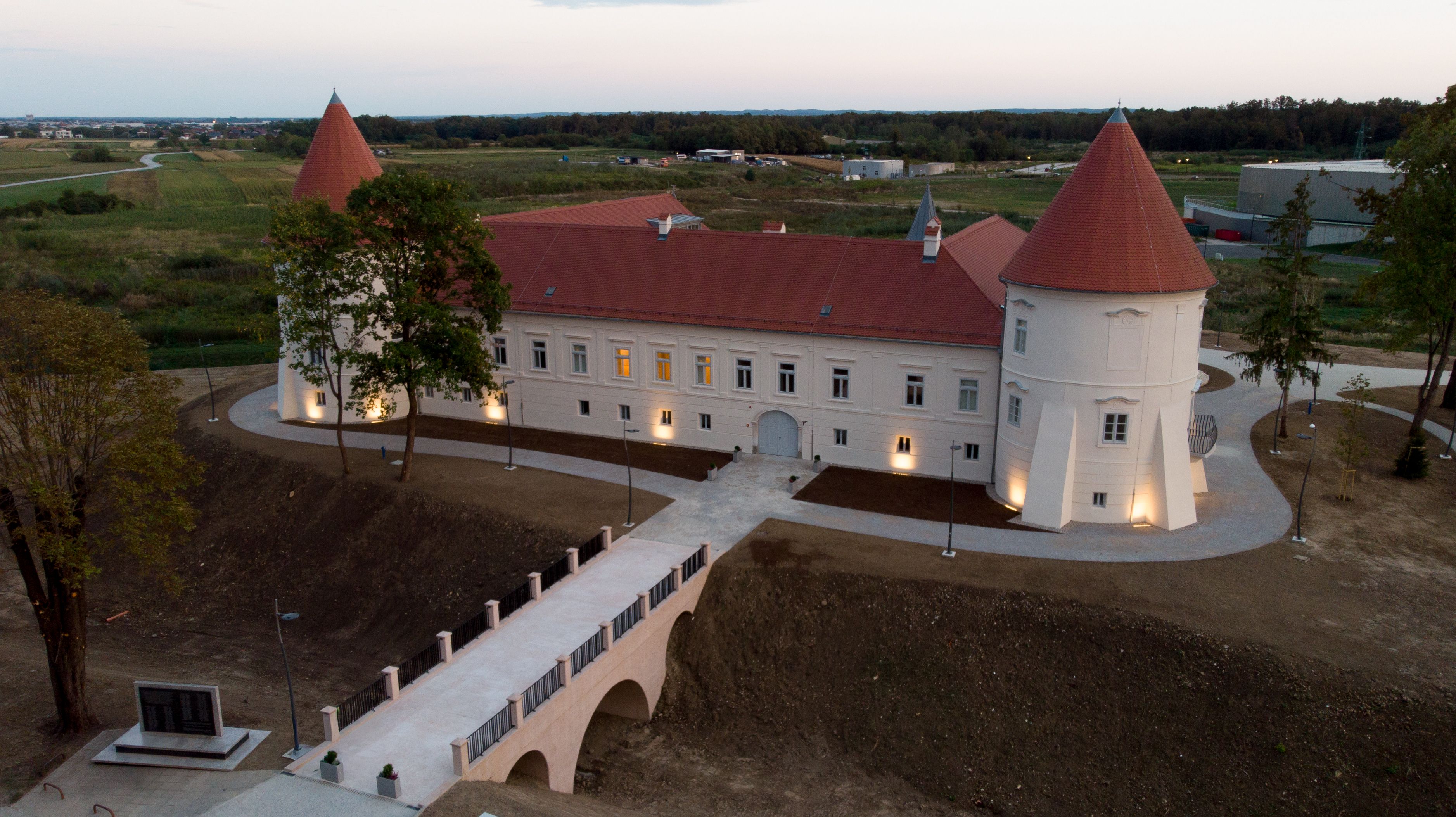
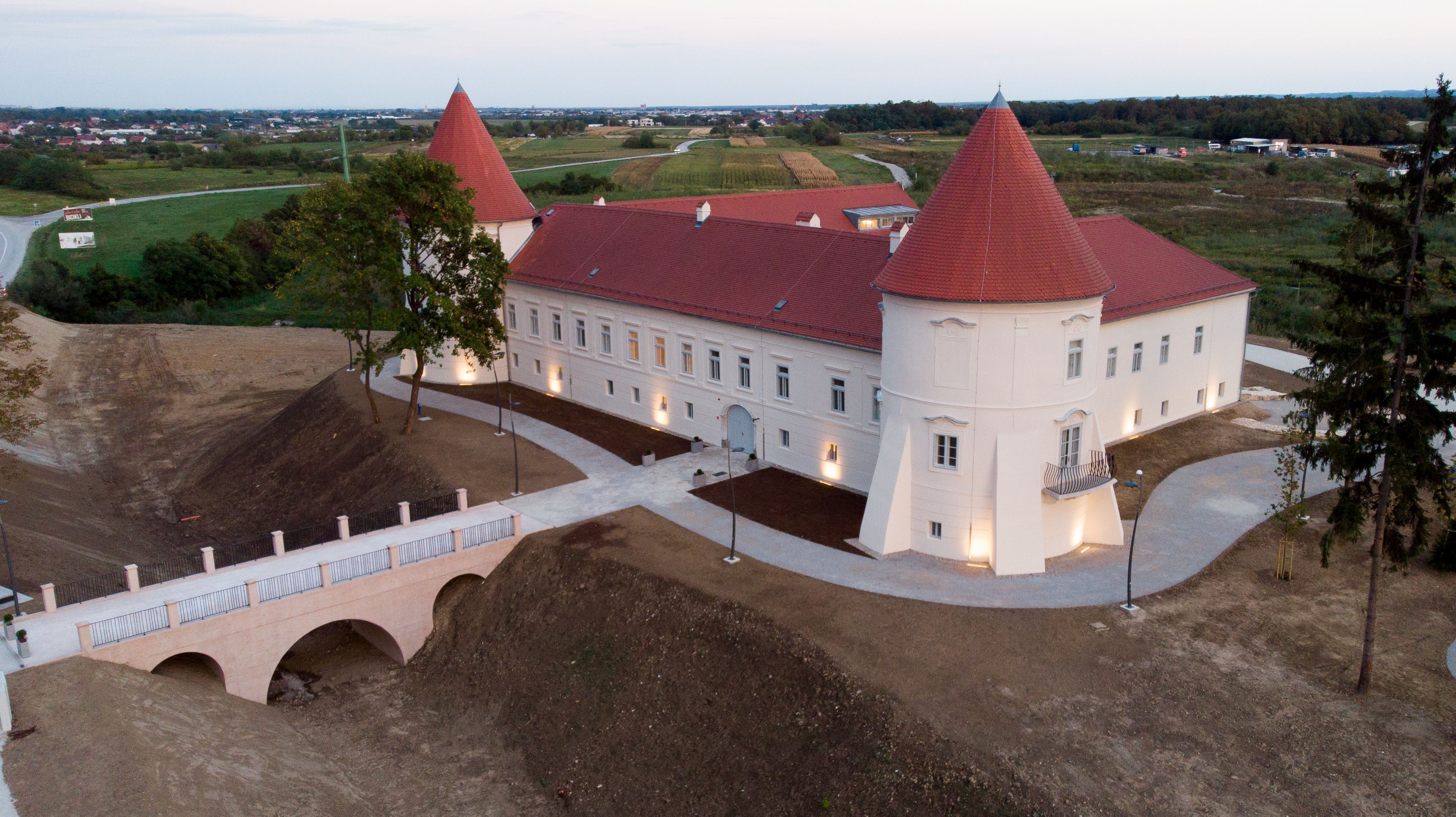
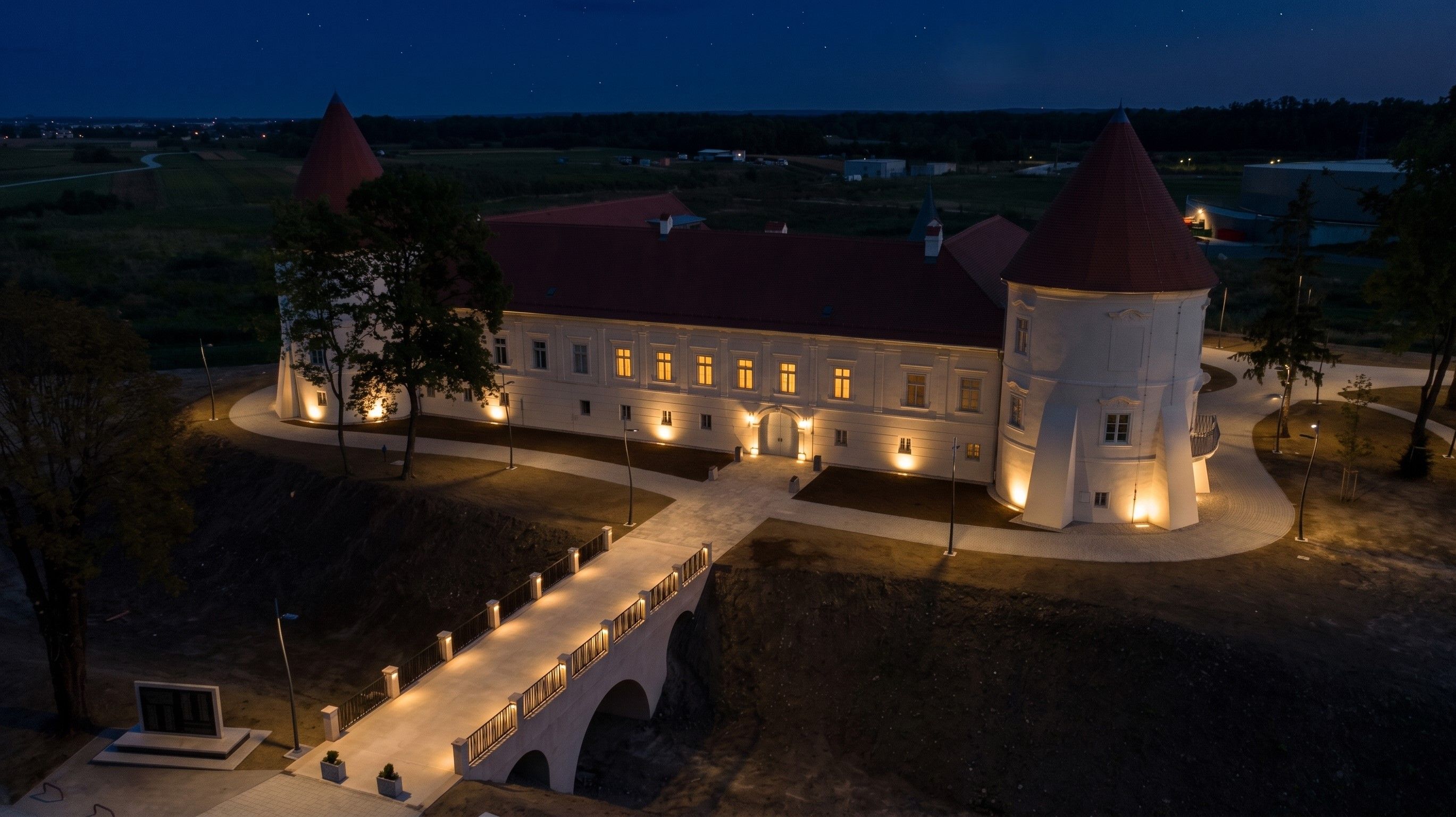
Kerestinec Castle stands on the plain, at the very edge of the village of Kerestinec, beside the Srebrnjak (formerly Bernica) and Korenjak streams. It is classified as a Renaissance lowland castle, predominantly defensive in character. The cadastral map of 1862 and photographs taken after the earthquake of 1880 show that the castle originally formed a closed quadrangle with four corner towers. On the north side, a chain bridge led to the main entrance across the moat that surrounds the raised platform on which the castle stands, and the moat was once filled with water from the nearby streams.
Recent conservation and archaeological research has established that the oldest parts of the castle date from the first half of the 16th century, and that the building was probably a manor house. The Kerestinec estate lay within the ancient seigneury of Okić, which in 1493 passed into the ownership of one of the most powerful Croatian noble families, the Erdődys. In that year it was bought by the Bishop of Zagreb and later Cardinal, Toma Bakač, who left it to his nephew Peter I Erdődy and his descendants.
II
Seat of the Erdődy family
The Kerestinec estate is first mentioned in 1555, when the Croatian Ban Peter II Erdődy probably pledged it (or gave it) to the Zagreb canon Juraj Herešinec, in return for services rendered and a sum of money lent to him. As early as 1560, Peter II Erdődy bought back the estate and its manor house from Bishop Petar Herešinec (the nephew of Juraj Herešinec), and the estate returned to the Erdődy family, in whose possession it would remain until 1852. Kerestinec soon became the seat of the Okić seigneury, which the family moved here from the fortress of Okić, by then neglected and difficult to reach.
Immediately after regaining the estate, Peter II Erdődy began building a castle with defensive towers. After his death in 1567, the work was taken over and completed by his son, Peter III Erdődy. Construction extended over several decades, although the sources state that the castle was built around 1575 (Baltazar Adam Krčelić), while Emilij Laszowski records a mention of the ‘castellum Kerestinecz’ in 1578. A document of 1587 survives in which Peter III confirms to the noble community of Cvetković that they had delivered 250 cartloads of stone for the further construction of the castle.
Peter III Erdődy made Kerestinec Castle his principal seat, and beside the parish church of the Holy Trinity in Sveta Nedelja he built the Chapel of St Peter as a family mausoleum, where he was buried together with his wife Suzana. From Peter III descends the so-called Croatian branch of the Erdődy family, whose seat was Kerestinec itself.
III
Revolt, Ottomans and Parliament
The pace of construction was shaped by the peasant unrest of around 1573 and by numerous Turkish raids at the end of the 16th century. In early February 1573, one of the decisive battles of the Peasant Revolt was fought at Kerestinec, in which the peasant army led by Ivan Pasanec faced the army of the nobility commanded by Vice-Ban Gašpar Alapić. In July 1592, Peter III Erdődy and his 40 horsemen successfully defended the castle against an Ottoman attack, while the lordships of Okić (that is, Kerestinec), Jastrebarsko and Samobor were laid waste in the autumn of 1592 and the spring of 1593.
During the wars of liberation from the Turks, when the Croatian Parliament (Sabor) could scarcely convene, sessions were held of the Croatian Royal Conference, a special parliamentary body that served as the de facto Croatian Parliament. One of these sessions took place at Kerestinec Castle on 7 May 1697, presided over by the Croatian Ban Adam II Batthyány.
IV
The Baroque and new owners
In the 18th century, once the Turkish threat had passed, the castle was remodelled and modernised in the Baroque style, while remaining a closed quadrangle with towers and a main entrance set off the central axis of the north front. In 1735 a chapel dedicated to the Blessed Virgin Mary of the Annunciation was built in the south wing and blessed by the Bishop of Zagreb, Juraj Branjug. North of the castle, to the east of the lake (fishpond), a park was laid out, and farm buildings were erected to the west.
The Baroque remodelling was undertaken by Count Ladislav Erdődy, a member of the so-called Hungarian, or Jastrebarsko, branch of the family, the descendants of Ban Thomas II Erdődy, to whom ownership passed after the Croatian branch died out in 1706. The Erdődy family owned the castle until 1852, when, owing to financial difficulties, it passed by court order to the Pallavicini family.
After the earthquake of 1880, which badly damaged the castle, the Pallavicini family sold it to the Türk family of Karlovac. The new owner, Franjo Aurel von Türk, undertook major works: he restored the north front, removed the south wing with its two towers and chapel, and demolished the second floor of the north and west wings.
V
The twentieth century
During the First World War the castle passed to the Hafner family, then to the Vošnjak family, and in 1922 it was bought by Antun von Mihalović, the last Croatian Ban of the Austro-Hungarian period and also the last private owner of the castle.
At the beginning of the Second World War, from late April to mid-July, the castle served as an Ustaša camp in which many intellectuals of the time were interned, among them Otokar Keršovani, Ognjen Prica and August Cesarec. After the prisoners escaped on the night of 13 to 14 July, the camp was closed and the castle became an officers’ school of the Independent State of Croatia (NDH). After the Second World War it served as a barracks of the Yugoslav People’s Army (JNA).
At the end of November 1991 the castle passed into the hands of the Croatian Army, which remained there until 2010, when it became the property of the City of Sveta Nedelja.